

Members of the Sorenson Impact Team Shared Their Expertise at SOCAP25
At SOCAP25, held October 27–29, 2025, in San Francisco, the Sorenson Impact team helped drive conversations about how capital can create meaningful, measurable change. During the event’s opening ceremony, founder Jim Sorenson reminded attendees that “markets, when guided by purpose, remain one of the most powerful tools for human progress, that capitalism can evolve, and that the same forces that once fueled extraction and inequality can now drive inclusion, resilience, and shared prosperity.” Building on that vision, the team joined investors, entrepreneurs, and changemakers to tackle some of the most significant challenges in the impact space.
Across three days of workshops and lively discussions, the team offered fresh perspectives on outcomes-based financing, nature-based solutions, and impact measurement — sparking new ideas and actionable solutions to help move impact from the margins to the mainstream. Here’s a look at four sessions in which Sorenson Impact leaders helped shape the dialogue and key takeaways that emerged.
Expanding the Nature-based Solutions Toolkit: Using Innovative Financial Models to Drive Scale
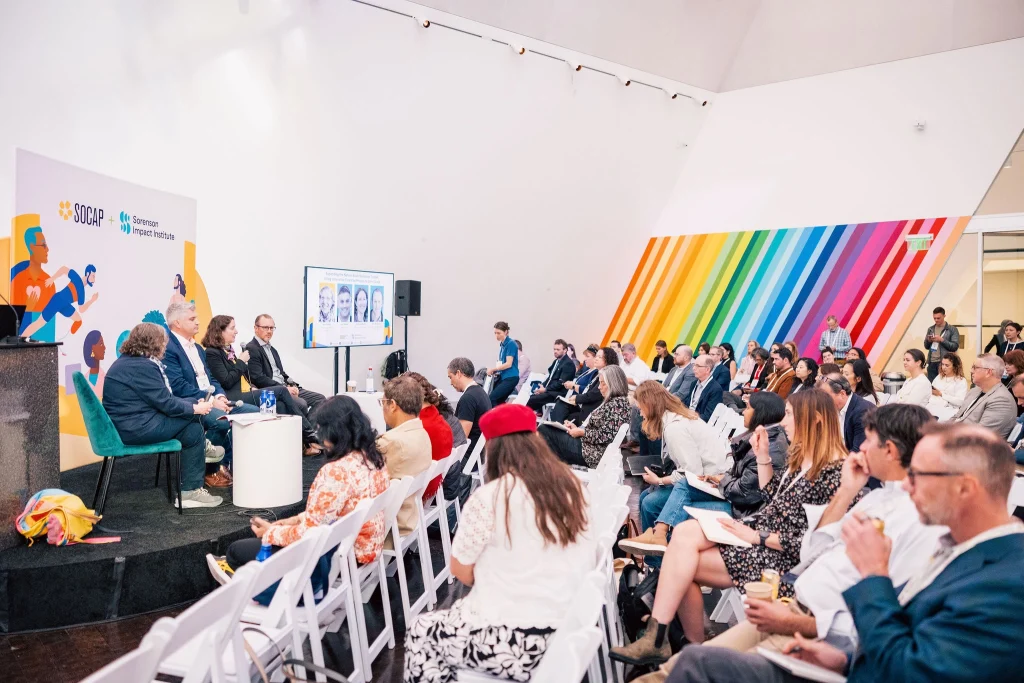
Moderated by Janis Dubno, Sorenson Impact Institute, and featuring Zach Knight, Blue Forest; Catherine Burns, The Nature Conservancy; Dan Winterson, Gordon and Betty Moore Foundation
Nature-based Solutions (NbS) remain underfunded — often due to concerns about long timelines, uncertain returns, and limited investor confidence. This session examined how innovative financial models, such as outcomes-based financing (OBF), can overcome these hurdles by translating long-term ecological and social benefits into near-term, investable outcomes. By aligning financial returns with short-term performance indicators, OBF and similar strategies can offer a powerful way to de-risk investment, unlock capital, and scale NbS. This discussion emphasized how effective financial design can positively impact both people and the planet.
“One of the transformations that I’ve seen over the last decade is around the rigor we can bring to measuring and validating outcomes. That’s really important when it comes to outcomes-based financing. You have to be able to measure, quantify, and validate the outcomes being delivered because they’re linked to returns. The more mature our science has gotten around measuring the outcomes associated with nature-based solutions, the closer we can get to really giving investors confidence that the impact that’s linked to the returns is bona fide impact. It gives the whole system more strength. … Make the business case. Investing in NbS is actually a very good business decision.” — Dr. Catherine Burns, Interim Managing Director of NatureVest, the impact investing and sustainable finance wing of The Nature Conservancy
“A lot of the time we ask, are you doing science or are you doing finance? In NbS, the science and the finance are one in many ways. … In NbS, we have targets that we have to reach to avoid catastrophic consequences. There’s no conflict between science and finance in NbS the way there sometimes is in the social sector.” — Janis Dubno, Managing Director of Impact Finance, Sorenson Impact Institute
“One of the biggest innovations for us was that we did these projects as one-off financings initially. We did the first one and then the second one, and then we heard from funders, ‘You know, you kind of made this up. You know how to diligence this better than we do. Why don’t you raise a pooled vehicle that can invest in every project as they become ready?’ It’s been an enormous unlock for us. We’ve launched five projects this year, and if I had to fundraise and structure each one, I would not have launched that many. Aggregating the investor piece into that has been incredibly valuable. It also helps us keep consistency so for all the partners that we lend to, it’s uniform across the board.” — Zach Knight, CEO, Blue Forest, which has developed innovative financial tools to support forest and watershed restoration, reduce wildfire risk, and strengthen the restoration economy
“The challenge is that you need to have the impact. You need a theory of change and the science to support the actual outcome, as well as a business model that will work. It seems obvious, but all of us naturally come at the problem from one of those two angles and have trouble seeing the other.” — Dan Winterson, Program Officer, Gordon and Betty Moore Foundation, which fosters scientific discovery, environmental conservation, and preservation of the Bay Area
For more on this topic: Read about the potential of scaling Nature-based Solutions with outcomes-based financing.
Be a Funding Magnet: How Mission-Aligned Partners Catalyze Mainstream Investment
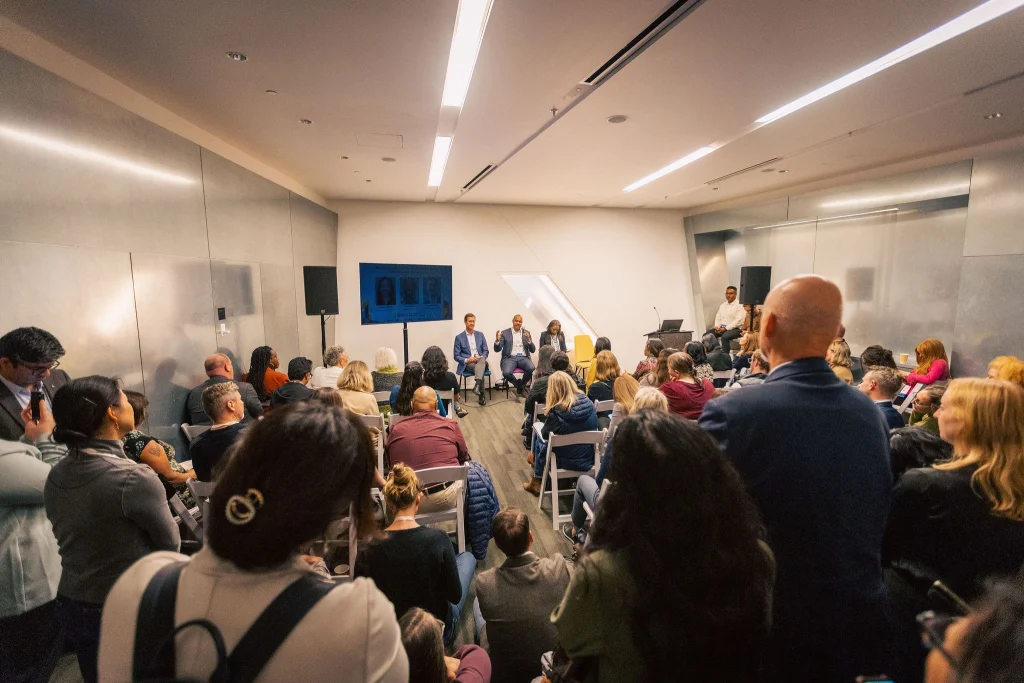
Featuring Dr. Nzinga Broussard, Sorenson Impact Institute; Omar Blayton, Sunwealth Power, Inc.; Jasper van Brakel, Regenerative Social Finance
For mission-driven founders, early-stage impact is often overlooked by mainstream finance. This interactive panel explored the role of mission-aligned lenders — those who take the first bet, prove impact is investible, and help unlock larger capital down the line. Panelists invited the audience to partake in a discussion about what these funders look for, how they assess risk, and how enterprises can better communicate their impact to attract aligned investment. Through real-world examples and a collaborative experience, participants walked away with insights they can apply directly to their work — helping to bridge the gap between early capital and long-term growth.
“There are three key areas a funder is focused on. One has to do with the business model. A funder always needs to take a look under the hood and look at sales, revenue, profitability, returns, scalability. The business model is key. … The second piece is risk. The third part is the people, the relationship side, understanding who the people are and if we are really in a partnership or if it is purely transactional.” — Jasper van Brakel, President & CEO of RSF, which raises and deploys capital to impact enterprises
“Start small. Attract bigger. You don’t have to raise a $15M fund out of the gate to do something. … I consider risk the lack of knowing. You don’t know what the outcomes are going to be. You have all these barriers. The biggest way to mitigate risk is transparency. You have to be able to arm your advocates with the knowledge they need to overcome the noes.” — Omar Blayton, CFO of Sunwealth Power, Inc., a renewable energy investment firm
“If you don’t have some of those things that funders are looking for, like a strong business model, they don’t care how impactful you are. … Impact measurement supports the business case. It is not the business case. … You have to have a strong impact thesis. I need to understand your theory of change. Everyone has a story, but oftentimes the story is not realistic to what you are actually doing. Stay specific to what you are doing and the change your solution can reasonably have.” — Dr. Nzinga Broussard, Senior Director of Impact Measurement at the Sorenson Impact Institute
For more on this topic: Learn how Dr. Broussard and her team at the Institute guided the Justice Climate Fund to better assess, measure, and communicate its impact.
Advocacy Alongside Capital: Activating Investor Influence for Scaled Impact
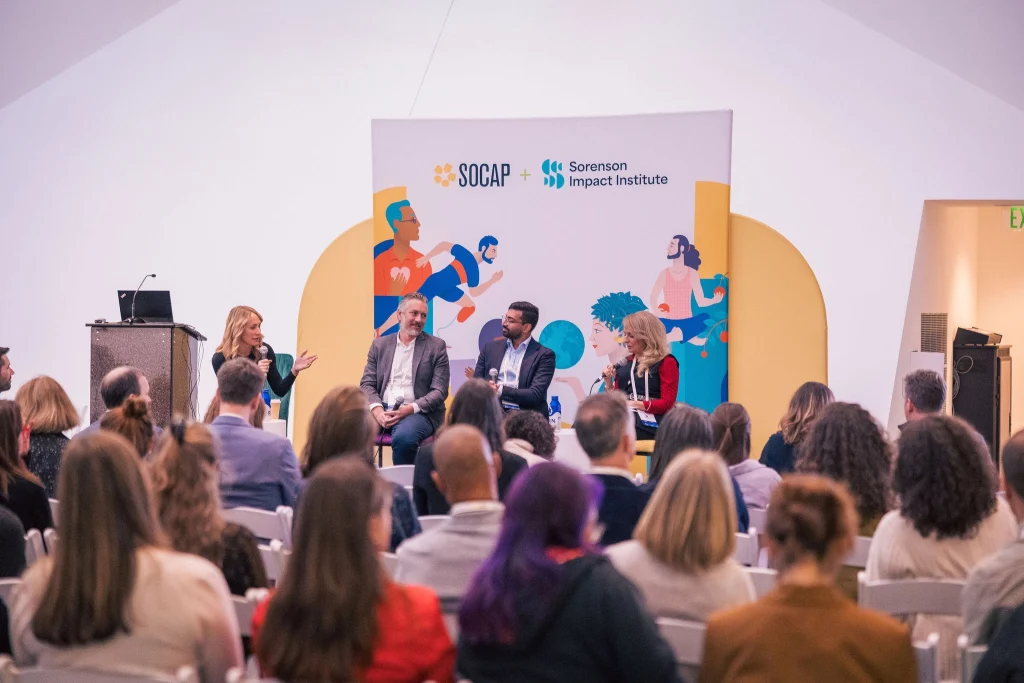
Moderated by Lindsay Zizumbo, Sorenson Impact Foundation, and featuring Jacob Haar, Community Investment Management; Luz Urrutia, Accion Opportunity Fund; Hari Joy, Blue Haven Initiative
As narratives around impact investment face political headwinds, policy advocacy and engagement can be a powerful complement to capital allocation strategies for investors seeking to drive impact at scale. This panel featured leaders who are bridging capital and policy to strengthen ecosystems and unlock lasting impact, particularly in the areas of financial inclusion and small business growth. Together they explored how aligning investment with advocacy can shape more equitable systems — and why investors need to engage beyond the balance sheet.
“It’s nice to see a tipping point in a way that folks are paying attention. And I think for most true impact investors, they say data transparency drives the difference.” — Lindsay Zizumbo, Executive Director, Sorenson Impact Foundation, a platform focused on making transformative investments in high-potential, but underserved markets around the world
“One thing we’re really bad at in the impact investing industry is telling the story. … Impact investing has significantly grown over the 20 years we’ve been doing this. There’s a lot of us now and the amount of money that has come into the space is massive. The trend is undeniable. It is unavoidable that impact investing is going to achieve a lot despite the naysayers. We just have to get better at telling that story.” — Jacob Harr, Founder & Managing Partner, Community Investment Management, dedicated to advancing fintech solutions across North America and emerging markets
“Fundamentally, capital is a form of soft power. Any time you’re providing capital to a startup, an initiative, you exert some type of influence. How do you translate that capital into advocacy and shaping systems in ways that align the impact we’re all looking for with the investment angle?” — Hari Joy, Managing Director of Private Investments, Blue Haven Initiative, an innovative family office dedicated to putting wealth to work for market returns and positive social and environmental change
“We’re not about politics. We’re about funding people who come to us and ask for a loan. This idea that somebody labeled us as ‘woke’ is incorrect. We aren’t favoring any groups. We’re favoring opportunity.” — Luz Urrutia, CEO, Accion Opportunity Fund, the nation’s leading non-profit that provides small businesses with access to capital, educational resources, personalized coaching, and thriving networks
For more on this topic: Watch the Institute’s virtual convening for more policy-enhanced impact investing strategies and insights.
Valuing the Priceless: Unlocking New Investment Through Nature’s Intangible Benefits
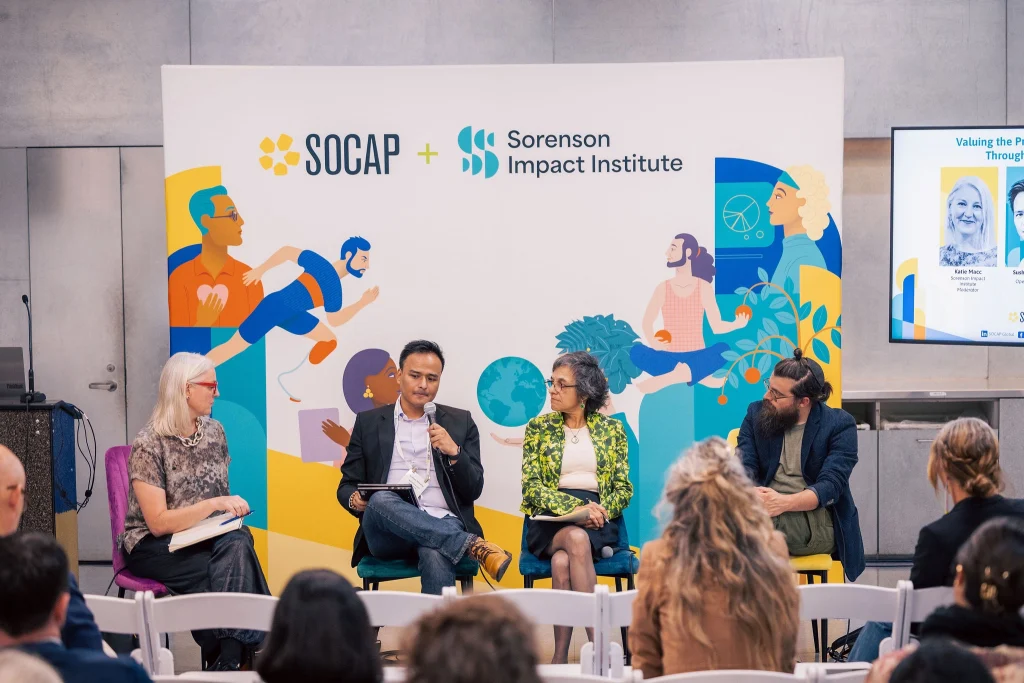
Moderated by Katie Macc, Sorenson Impact Institute, and featuring Dr. Nalini Nadkarni, Sorenson Impact Institute; Sushant Shrestha, Open Future Fund; Ariel Mayse, Stanford University
Nature offers more than resources — it shapes our cultures, uplifts our spirits, and anchors communities. Yet these intangible values remain overlooked in traditional markets. This session explored how assigning value to nature’s spiritual, cultural, emotional, and aesthetic benefits can unlock new investment pathways for Nature-based Solutions (NbS). With three panelists offering unique insight, research, and life experience, the conversation explored how expanding the metrics of value beyond carbon and commodities can open the door to more inclusive, impactful, and financially viable environmental solutions. Participants were invited to reimagine how we define — and invest in — nature’s true worth.
“One of the reasons we’ve had a hard time getting investment in nature to stick is because the people making investments have lost that intangible connection to nature. … None of us is disputing the science. But it’s almost like the jury is still out. Are you going to do anything about it? That’s our call in this space. Change the narrative. Reconnect our souls to the nature that sustains us.” — Katie Macc, CEO, Sorenson Impact Institute
“Nature’s intangible benefits — beauty, spirituality, well-being — can lead to both human benefits and financial profit. … We need information, research, documentation, and evidence-based work so we can make a case that nature’s intangible benefits aren’t just out there and woo-woo but have outcomes that are beneficial and profitable.” — Dr. Nalini Nadkarni, Senior Fellow in Residence, Sorenson Impact Institute; National Geographic Explorer at Large
“People start out wanting to do this, and it quickly changes when you look at the economic realities. … There is that need and hunger … there is a need for bigger players to be involved in this work. It’s happening, but not enough. … I have radical hope because just having this kind of conversation, it feels like there’s something possible. There’s sincerity here, there’s strategy here. That to me is very hopeful.” — Sushant Shrestha, Managing Partner, Open Future Fund, where he advances the concept of contextual capital, investing with awareness of cultural, ecological, and systemic interdependencies
“[Religious teachings] remind us of an important truth: the world as it is is not the world as it must be, and that things can be otherwise. Our vision has become constrained and cramped. We need to expand our ways of defining terms like ‘value,’ ‘return,’ ‘investment,’ and perhaps even the market itself. Markets are complex, multifaceted beasts, and they are far from passive. They shape us and our lives, reflecting an array of values beyond simple efficiency. They must also have limits. Not everything that can be sold ought to be sold or can be done so morally. And the value of some things lies not within cost-benefit analysis but outside of it.” — Ariel Mayse, Associate Professor of Religious Studies, Stanford University
For more on this topic: Learn about the Institute’s series of applied research projects and strategic initiatives to help expand the market for NbS.


