
Sorenson Impact Institute Virtual Convening Series
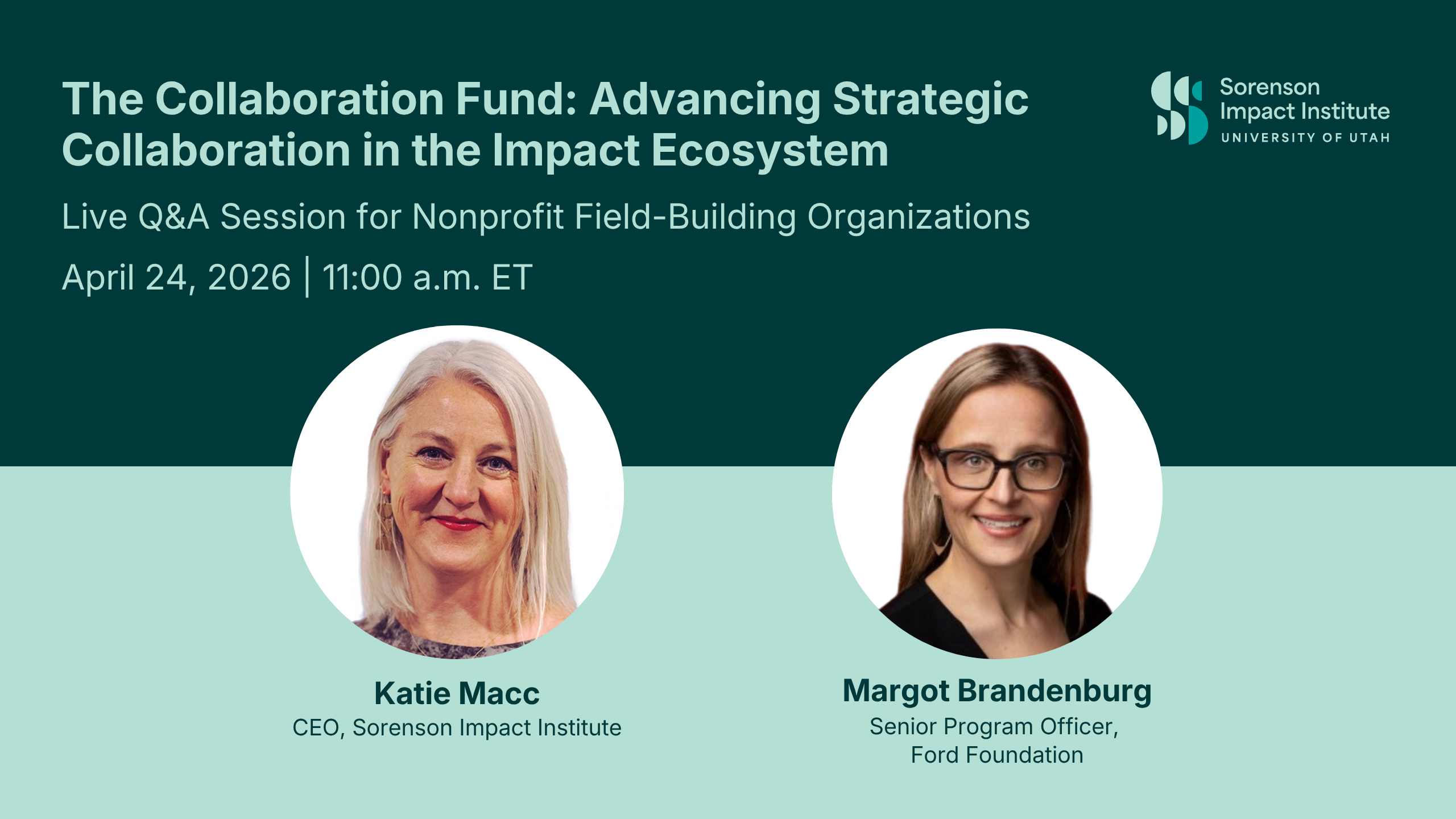
The Collaboration Fund: Advancing Strategic Collaboration in the Impact Ecosystem
April 24, 2026 | 11 a.m. ET
A Live Q&A Session for Nonprofit Field-Building Organizations
The Collaboration Fund is a $1 million pooled grant fund that aims to strengthen the impact investing ecosystem by reducing fragmentation and financial stress among nonprofit field-building organizations in the impact investing and inclusive capital ecosystems. In response to inquiries since the fund’s launch, this live Q&A is designed to share more about this opportunity and answer questions.
At our informational session on April 24, 2026, at 11:00 a.m. ET, Katie Macc, CEO of the Sorenson Impact Institute, and Margot Brandenburg, Senior Program Officer at the Ford Foundation, provided an overview of the Collaboration Fund RFP, including its goals, qualifications, and potential uses of proceeds, and addressed questions received. Attendees were encouraged to bring questions for the live Q&A at the end.
About The Collaboration Fund
A $1 million pooled grant fund that includes an anchor commitment from the Ford Foundation and support from the John D. and Catherine T. MacArthur Foundation, the Collaboration Fund will support strategic collaboration and consolidation among nonprofit field-building organizations in the impact investing and inclusive capital ecosystems. Launching at a critical moment, the Collaboration Fund seeks to reduce fragmentation and financial stress across these organizations. The RFP supports mergers, acquisitions, and other forms of deep collaboration by helping finance integration costs.
Our Past Virtual Convenings:

Democratizing American Prosperity:
Unlocking Economic Opportunity for All
In the past 2,000 years, no society has ever reduced wealth inequality on the scale we currently face in America without one of four forces: mass-mobilization warfare, transformative revolutions, state collapse, and catastrophic plagues. In other words, grossly unequal societies have become more equal only when vast amounts of wealth have been destroyed.
The conversation builds on the insights shared in the article, Pathways To Building Wealth For All, which highlights a crucial paradox: while American capitalism has been a tremendous force for wealth creation, the benefits of that prosperity have been vastly inequitable. Today, the top 1% of households own nearly 30% of all wealth, while the bottom half own just 2.5%.
Yet, what if the solution isn’t less capitalism—but more? By expanding access to the mechanisms of wealth creation—homeownership, retirement savings, and employee stock ownership—we can bridge these gaps and create a more inclusive economy.
In this discussion, we explored actionable solutions for broadening economic participation to ensure that free markets work not just for the few but for the many. We examined policy innovations, investment strategies, and ways businesses and individuals can join the movement to democratize prosperity.

Empowering the Next Generation of Changemakers: Students, Impact, and Social Change
Few actions yield a greater impact on our world than empowering the next generation of leaders. As we seek to prepare students to help create a more equitable and sustainable future, a collaborative approach between educators and businesses is a powerful key to unlocking opportunities for learning and experience.
Join us for a free interactive convening on March 6 from 4-5:00 p.m. ET to explore how the combined power of education and business can drive positive change in the world. Together with leaders from the Sorenson Impact Institute, Harvard Business School’s Social Enterprise Initiative, and the Center for Social Innovation and Entrepreneurship at the University of San Diego, we will discuss the trends, opportunities, and challenges that colleges and universities face in equipping and preparing students who are committed to positive social change.

Policy-Enhanced Impact Investing: Amplifying Returns Through Policy Awareness & Intervention
A Sorenson Impact Institute Virtual Convening in partnership with Blue Haven Initiative
Impact investing is a powerful tool for creating positive social and environmental change. However, it is deeply influenced by policy environments, which can hinder or accelerate progress.
The Sorenson Impact Institute and Blue Haven Initiative held a virtual convening from 4:00 to 5:00 p.m. ET on October 9 to explore the critical intersection of impact investing and policy interventions, revealing how investors can leverage policy to enhance their impact and returns.
Policy awareness can significantly influence the effectiveness and outcomes of impact investments. By understanding the policy landscape, investors can identify opportunities, mitigate risks, and align their strategies with supportive regulatory environments. Despite this potential, many investors have yet to fully integrate policy considerations into their approach. This gap represents an opportunity for forward-thinking investors to develop more comprehensive strategies that consider both financial and policy-related factors in their decision-making process.
This conversation featured host Lindsay Zizumbo of the Sorenson Impact Foundation, moderator Liesel Pritzker Simmons of Blue Haven Initiative, and panelists Louis Caditz-Peck of the Responsible Business Lending Coalition, Ryan Werder of the Energy Action Fund, and Jacob Haar of Community Investment Management.

Financing Women and Women of Color Entrepreneurs in Utah
In 2023, Utah was ranked one of the top 10 states for business for its skilled workforce, robust economy, and business-friendly environment. Yet a recent study by Clarify Capital revealed that Utah ranks among the worst states for women-owned businesses, highlighting a stark gender disparity in the state’s business environment. Differing attributes of women- and men-owned businesses — such as workforce size, industry, and operational histories — in Utah contribute to challenges in accessing capital, even when accounting for factors like financial literacy, mistrust of financial institutions, and business sophistication. This disparity also represents an opportunity for financial institutions, which are currently underserving an important sector of the business economy.
Attendees heared first-hand from Utah-based entrepreneur McKenzie Bauer as well as representatives from financial institutions as we discussed the challenges and opportunities to remove barriers to access to capital.
In this conversation, host Dr. Nzinga Broussard of Sorenson Impact Institute and moderator Danielle Wright of J.P. Morgan Private Bank were joined by panelists Sara Day of Utah Microloan Fund; Mary Milodragovich of MoFi; and McKenzie Bauer of Thread Wallets and Female Founders Only.

Bridging the Affordable Housing Gap With Impact Real Estate
The United States and Canada face a severe shortage of affordable housing. Over the last 20 years, the U.s. developed a gap of 5.5 million housing units, while in Canada, the gap amounts to 3.5 million. The staggering number continues to rise, compounded by soaring construction costs, inflation, and steadily increasing interest rates. Both renters and buyers feel the burden — nearly 50% of renters in the U.S. and over 43% of recent renter households in Canada spend more than 30% of their income on housing.
How can we allocate capital to alleviate the burden of housing costs felt by so many and create affordable, sustainable living situations for millions of people?
On Thursday, December 7 at 4:00 p.m. ET, Sorenson Impact Institute hosted an insightful conversation with impact leaders who are forging innovative solutions to bridge the housing gap. Sorenson’s Alan Lo was joined by experts in real estate impact investing: Kate Murray, Director of Impact Strategy and Measurement at TAS, a Canadian impact company that uses real estate as a tool to drive profit and purpose; and Jeremy Keele, Co-Founder and Managing Partner of Catalyst Opportunity Funds, a real estate impact investment firm focused on transformative investments in historically underserved markets.

Accelerating Social Change with Pay For Success Financing
Pay for Success (PFS) is an outcomes-based financial model used to fund effective solutions to social challenges. The Impact Finance team at the Sorenson Impact Institute helps partners fund and execute evidence-based PFS projects, driving measurable results and lasting impact for underserved communities.
At this virtual convening, attendees learned how to successfully implement the PFS financing tools that build community resilience by allocating resources to results. The Institute’s Director of Impact Finance, Janis Dubno, was joined by representatives from The Institute for Child Success (ICS) and Maycomb Capital, both leaders in outcomes-based financing.

Community-Engaged Impact Measurement
This conversation was hosted by Sorenson Impact Institute Chief Operating Officer Katie Macc, Dr. Tiana Rogers, the Institute’s Senior Director of Impact Strategy, and Paul Kuttner, Associate Director at University Neighborhood Partners (UNP). UNP builds partnerships with the University of Utah and west side Salt Lake County neighborhoods, uplifting historically underrepresented voices to advance reciprocal learning, action, and benefit.
Dr. Rogers and Kuttner shared how the Institute recently helped UNP identify approaches to better demonstrate their impact and ensure community priorities remain at the core of their impact measurement efforts.
About Sorenson Impact Institute’s Virtual Convenings
Sorenson’s Virtual Convening Series features solutions-oriented discussions with members of the Institute and its community of impact leaders. Together we take a deep dive into the most pressing issues of our time, exploring challenges, opportunities, and learnings to scale actionable solutions.
Be the first to know when a new convening has been scheduled by joining our mailing list: